Fulcrum · Leverage measurement for AI-native engineering
The leverage record
your board can audit.
Fulcrum logs every agent-assisted task at the time of the work: the senior-engineer hours it would have taken, the agent minutes it took, and the operator minutes you spent. It turns “we use Claude Code” into an execution factor you can defend, publish, and improve.
$1,199 per year · installed in your environment · included for a year with every Vantalect Engineering Leverage engagement

- 31×Aggregate execution factor, a ratio of sums over every logged task
- 3,552Tasks logged since February 22, 2026, every row published
- 22.5×Median task factor: the middle task, not the mean
- 1Engineer: one operator with full product authority
Fulcrum is the instrument behind the public leverage record at charlessieg.com/leverage. It is measured on Charles’s own build, not promised for yours. Yours gets measured.
How the engagement measures
One number, one gate,
the same instrument twice.
The Engineering Leverage engagement installs Fulcrum in your environment on day one, so week six is measured with the same instrument as week one.
- The factor
Senior hours per agent minute
The aggregate execution factor is
60 × sum(H) / sum(A): H is the qualified-senior-equivalent hours a task would take, A the agent session minutes it took, both summed over every logged task. It is a ratio of sums, not a mean of ratios. - Week one
The baseline
Two weeks of logged tasks become a written baseline report: the aggregate execution factor, the median task factor, coverage, and the per-project breakdown, plus the raw export.
- Week six
The gate
The week-six measurement runs against week one, with the same method on the same kind of work. The second half of the six-week fee is invoiced only if the measured lift is at least 3× your week-one baseline.
What a record holds
Measured facts on one side.
Estimates on the other. Never mixed.
Every field belongs to one of four evidence classes, and the dashboard never lets an estimate pose as a measurement.
- 01
Measured execution
Captured at the time of the work, not reconstructed afterward.
- Agent-session minutes and wall-clock span
- Token counts with exact, estimated, or unavailable provenance
- Provider, model, session, repository, and commit
- Prompt, supervision, correction, and review minutes
- 02
Estimated counterfactual
How long the work would have taken without the agentic path, with its basis and author on the record.
- Qualified-senior-equivalent hours
- An optional operator-unassisted low, likely, and high range
- Estimate basis and author: agent, operator, or joint
- Feasibility: can do, can do with learning, not reasonably feasible
- 03
Operator conditions
The circumstances the result was produced under, recorded as boundaries rather than multipliers.
- Experience and product authority
- Work cadence and tooling
- Subscriptions and parallel orchestration
- Never used as a multiplier coefficient
- 04
Capability expansion
Work that needed substantial new learning, or was not feasible unaided, is classified rather than assigned an invented hour count.
- Time compression, skill extension, or otherwise infeasible
- Counts and shares, never a fabricated multiplier
- A concise rationale travels with the classification
- Historical estimates are never multiplied in place
Inside the product
What the dashboard shows.
The dashboard gives the summary, the leverage trend, and the project breakdown. The cost page prices the same work by model and by activity. Both run in the dark and light themes, and the records list reads on a phone.


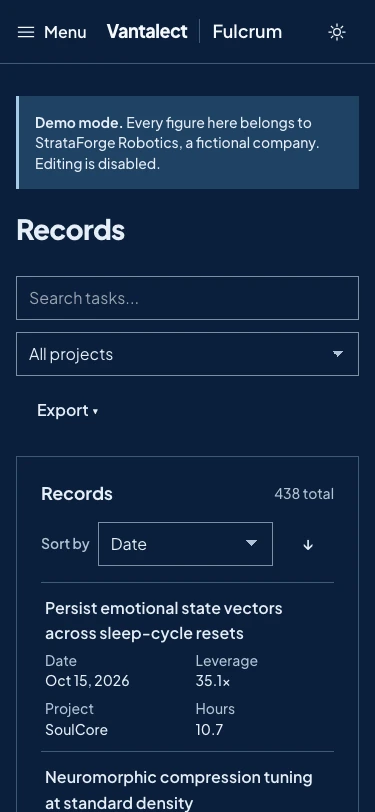
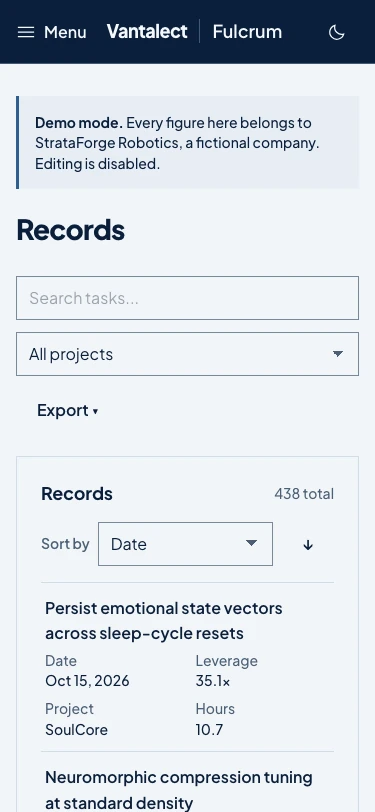
Demo data. These screenshots come from a demonstration installation. Every figure in them belongs to StrataForge Robotics, a fictional company, and none of it is a customer’s record.
How it works
Recorded by the agent. Reviewed by you.
Published on your terms.
The record is written while the work happens, by the tool that did the work, and confirmed by the person who supervised it.
- 01
Record
At the end of a task the agent calls
record_leverageover MCP, or you runleverage add. A client-generated record id makes every retry idempotent: the same task never lands twice. - 02
Review
Drafts become confirmed records in the dashboard. Corrections keep the original row and supersede it, so the ledger is auditable end to end.
- 03
Publish
Confirmed, reviewed records feed the summary, the time series, the team leaderboard, and, if you choose, an immutable public snapshot with a manifest and hashes.
Every surface your team already uses
Agents write it.
People read it.
One PostgreSQL-backed service behind four front doors, so the record gets written by whatever did the work.
- MCP server. Tools an agent calls directly, from
record_leveragetoget_fatigue_assessment. - CLI.
leverage addfrom any shell, idempotent by record id. - REST API. API keys, mTLS, or JWT, with the same service layer underneath.
- Dashboard. Summary, time series, per-project breakdown, teams, and cost, in light and dark.
The part nobody else measures
Decision fatigue,
on the record.
By the thirteenth task of the day the operator has made hundreds of supervisory decisions. Fulcrum counts them, scores the day, and hands the agents guidance to match: fewer questions, more conventional defaults, completed work instead of options.
| Records today | Level | What the agents do |
|---|---|---|
| 0–3 | Low | Normal operation. Present options, ask clarifying questions. |
| 4–7 | Moderate | Fewer questions. Reasonable defaults when intent is clear. |
| 8–12 | High | Minimize decision points. Front-load the reasoning. |
| 13+ | Very high | Maximum autonomy within the constraints. Present finished work. |
Published metrics
Six numbers, each with a formula.
None called “average leverage.”
The ratio of sums is not the mean of ratios, and Fulcrum refuses to blur them. Every published figure carries its formula identifier and its coverage.
Aggregate execution factor
60 × sum(H) / sum(A)The primary execution metric: senior-hours saved per agent minute, summed over every record.
Median task factor
median(60 × H / A)The middle individual task, immune to the outliers that dominate a mean.
Aggregate operator leverage
60 × sum(H) / sum(O)Senior-hours per operator minute, over records with complete operator-time coverage, with the coverage count published beside it.
Calendar compression
60 × H / wall_clockHow much sooner the work landed. At period level the denominator is the union of intervals, never a naive sum.
Arithmetic task mean
mean(60 × H / A)Kept for continuity and labeled as the task mean, never presented as the headline.
Capability expansion
counts and sharesHow much of the work was skill extension or otherwise infeasible unaided, reported as counts, never as an invented factor.
Licensing
One license. Your environment.
$1,199 a year.
Fulcrum is licensed for installation where your engineers already work, not sold as a hosted subscription. The record it builds is yours, whether or not you renew.
- Annual license
Fulcrum
$1,199 per year
The API, the dashboard, the CLI, and the MCP server, installed in your environment, with every release shipped during the term. Renews at the same price, only if you choose to continue.
Request a license - Included
With Engineering Leverage
Year one included
Both the Assessment and the Embed install Fulcrum on day one under a one-year license, the full product and not a trial. Then $1,199 per year, only if you choose to continue.
See Engineering Leverage
- Term
- One year from installation
- Where it runs
- Your environment: any host that runs containers and PostgreSQL 17
- Your data
- Stays in your environment; yours to keep and export whether or not you renew
- Support
- Email, with the installation runbook and the measurement contract
Vantalect, LLC delivers the engagements. Fulcrum is a product of Renkara Media Group, Inc.
Client sign-in
Fulcrum runs in your environment,
so it has no sign-in here.
Your people sign in to your own installation with the identity provider you already use (OpenID Connect), and services and scripts use API keys or mutual TLS. This site offers no sign-in. If you need help with an installation, write to charles.sieg@vantalect.com.
Questions
What people ask first.
Is there a hosted version?
No. Fulcrum is licensed for installation in your environment. The record it builds is the kind of thing a company should hold itself, and keeping it in your environment is the whole point of the license.
Does our data ever leave our environment?
Not unless you publish it. The optional snapshot contract produces a public build you can host yourself; nothing is sent to Renkara.
How do our agents write to it?
Through the MCP server, which any MCP-capable agent can call at the end of a task; through the CLI from any shell; or through the REST API with an API key. All three use the same service layer.
What is the 31× on this page?
Charles’s own measured record: 3,552 tasks logged since February 22, 2026, published in full at charlessieg.com/leverage. It is an upper-tail record of one operator with full product authority and no handoffs. Your number gets measured, not assumed.
Whose figures are in the screenshots?
Demonstration data. Every figure in the dashboard screenshots belongs to StrataForge Robotics, a fictional company, and none of it is a customer’s record.
Can more than one team use one license?
Yes. Users belong to teams, teams have leaderboards, and the license covers the installation, not a seat count.
What happens if we do not renew?
The license ends. The software you installed keeps running, your database stays yours, and you can export everything. There is no contract to cancel.
Claude Code is a trademark of Anthropic, PBC. Vantalect is not affiliated with or endorsed by Anthropic.
The next conversation
Let's define the result.
Fulcrum comes with the Engineering Leverage engagement. Tell Charles what your team is building and where the work slows down, and he will scope the measurement.
Remote engagements nationwide.
Serving clients since 2020.